
Bonus Room Ideas: A Two-Zone Layout for a Long, Narrow Room
By The Poco Koko team · Updated Nov 17, 2026 · 5 min read

Shown in our 6.5 × 10 ft size, on the way.
On this page
The easiest way to set up a bonus room is to split it into two zones, with a soft play floor at one end and a grown-up spot, like a sofa and TV or a desk, at the other. Then lay the play mat with its long side along the long wall, so the walkway runs down the open side of the room.
This plan works because most bonus rooms are long and narrow. A room over the garage or at the top of the stairs often has a low, sloped ceiling on one or both sides, and a single rug in the middle fights that shape instead of working with it.
Why bonus rooms feel hard to furnish
A bonus room is often a leftover space, such as a long room tucked under the roof with a stair opening at one end and a window at the other. The floor is there, but the walls are short, slanted or broken up by doors and closets.
The usual living room plan, a sofa facing a TV with a rug in between, tends to leave a lot of empty floor at one end of a room like this. Splitting the room gives each end one clear job. For more ways to plan a whole room around one soft floor, see our room-by-room playroom ideas.
Split the room into two zones
Stand in the middle of the room and look both ways, because one end will usually feel more open and a little more tucked away. That end becomes the play floor, and the other end belongs to the grown-ups.
- The play end: the mat on the open floor, a low shelf or two baskets along the wall, and a few books.
- The grown-up end: a sofa or a pair of chairs, a TV or a desk, and a lamp.
- The walkway: a clear strip down one long side, from the door to both ends.
Keep the walkway free of baskets and toys at all times. In a narrow room it is the only way through, so it needs to stay open for anyone carrying a laundry basket or a tray of snacks.
Play mats for the living room
Size the mat against the room
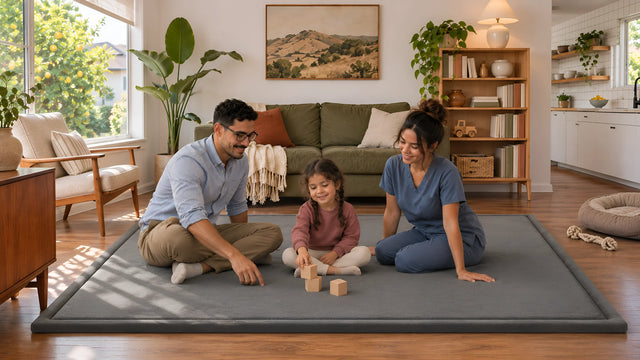
This is the part to measure before you buy anything else. Our Living Room size is 5 × 6.5 ft (59 × 79 in), about the size of a queen bed, and when you lay it with the long side along the long wall of a bonus room, it gives the play end a single soft floor and still leaves the walkway open beside it.
| Mat size | Where it suits | How to lay it |
|---|---|---|
| Living Room, 5 × 6.5 ft (59 × 79 in) | the play end of a bonus room, or a play nook at one end | long side along the wall |
Say the room is 12 ft wide. A 5 × 6.5 ft mat set with its long side along one wall leaves about 7 ft of open floor beside it, which is enough for the walkway and for a grown-up sitting at the edge. For a bigger room, larger 6 × 9 ft and 6.5 × 10 ft sizes are on the way.
Before you choose, tape the outline on the floor with painter's tape and leave it there for a day, so you can see how the family moves around it. Our guide to mat sizes lays out every size side by side.
Lay the mat along the long wall

Seats go next to the mat, never on it.
Once you know the size, set the mat toward the long wall at the play end, square to the wall so the room looks tidy from the door. The mat is one piece, so there are no seams to line up and no puzzle tiles to pull apart.
A sofa or chair should sit next to the mat, not on it, because our care page says to keep furniture off the mat and off its edges. A grown-up can still sit right at the edge and stay within easy reach of the kids.
This end of the room is where babies and toddlers can do tummy time, crawl, build towers and look at books with you. For awake, supervised play. Not for sleep.
Work with a sloped ceiling
Sloped ceilings are common in bonus rooms, and they matter more for the grown-ups than for the kids. Children play low to the floor, so the low side of the room suits them, while parents are the ones who bump their heads.
- Leave standing room: set the mat a little in from the lowest part of the slope, so a parent can kneel and stand up without ducking.
- Use the knee wall: a row of low baskets fits well under the slope, where nothing tall can go.
- Mind the window light: strong, direct sun can fade any fabric over time, so a spot out of the brightest skylight glare helps.
Keep the play end away from the stairs
Many bonus rooms open right onto a staircase, so put the play end at the far end of the room, away from the stair opening.
The Consumer Product Safety Commission advises using safety gates to help prevent falls down stairs, and it says that for the top of stairs, you should only use gates that screw to the wall. Safe Kids Worldwide also advises keeping stairs well lit and clear of clutter.
Ideas for the grown-up end
The other end of the room can do almost any job, so pick the one your family will use most often.
- A TV corner: a sofa facing a wall-mounted TV, with the play end behind or beside it. Our notes on the rug between the sofa and the TV help with that spot.
- A desk nook: a desk under the window, where a parent can work and still see the play end.
- A guest corner: a daybed against the end wall for visits.
- A craft table: a small table and chairs set next to the mat, never on it.
If you are still deciding how much of the room should go to play, our look at whether a dedicated playroom is worth it walks through the tradeoffs.
Storage for a long room

Low baskets fit under the slope, where nothing tall can go.
In a long room, storage works well along the walls and close to where things get used, so toys stay at the play end and grown-up things stay at the other.
- Low shelves at the play end: books and baskets kids can reach from the mat.
- Lidded bins under the slope: for toys you are rotating out.
- A closed cabinet at the grown-up end: for games, cables and remotes.
Anchor any shelf or cabinet to the wall, and keep toys off the top of furniture so nobody is tempted to climb for them. At the end of the day, a quick vacuum pass keeps the mat looking like a rug instead of a play zone.
FAQ
What is the easiest layout for a bonus room?
Split it into two zones, one at each end, with the play floor at one end and a seat, TV or desk at the other. Keep a clear walkway down one long side so nobody has to cross the play floor.
Which mat size suits a long, narrow bonus room?
The 5 × 6.5 ft size, laid with its long side along the long wall, gives a long room a soft play end and still leaves the walkway open beside it.
Where should the play area go if the room has stairs?
Put it at the end of the room farthest from the stair opening. At the top of the stairs, use a safety gate that screws to the wall.
Can a sofa sit on the play mat?
No. Keep furniture off the mat and off its edges, and set the sofa or chair right next to the mat so a grown-up can sit close by.
Give your bonus room one soft play end with a mat from our living room play mat collection.
Written by the Poco Koko team.
- Free shippingContiguous U.S. (48 states)
- Pre-orderShip timing is on each mat's page
- 30-day returnsOn unused mats
- 1-year warrantyOn every mat