
Hand-Tufted vs Hand-Knotted Rugs: How They Differ and Where Each Belongs
By The Poco Koko team · Updated Nov 18, 2026 · 6 min read

Shown in our 6.5 × 10 ft size, on the way.
On this page
A hand-knotted rug is made one knot at a time on a loom, so it takes far longer to produce, usually costs considerably more and tends to last much longer. A hand-tufted rug is made with a handheld tool that punches yarn through a cloth backing, which is then glued. From the front it can look very similar, but it comes together faster, costs less and often wears out sooner.
Both can be beautiful in a family home, yet neither one is designed for daily spills, crayons and crawling. Below, you'll find how each type is constructed, how to tell them apart, how they feel, shed and clean, and how to keep a special rug looking good while little ones play nearby.
The short answer
Choose a knotted rug if you want a piece to keep for decades and the budget allows it, and choose a tufted rug if you love the handmade look for less money. Either way, keep it in the seating area where grown-ups relax, and give everyday play its own separate spot on the floor. Our guide to a play mat that looks like a rug shows how a rug and a play area can comfortably share one room.
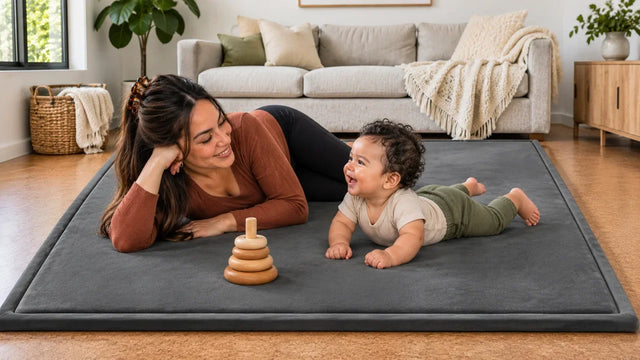
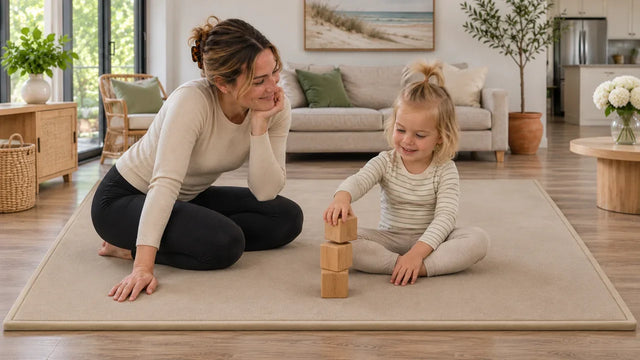
Our play mat is built differently from both rugs: one continuous piece of Loft Foam under a velvety-soft plush top, with a non-slip backing fabric and an edge finished like a real rug. There are no tufts punched through a backing, no individual knots and no seams on top.
How a hand-tufted rug is made
The maker stretches a sheet of cloth tightly across a frame and draws the design directly onto it. Then a tufting tool, which works a bit like a handheld gun, punches loops of yarn through the cloth, row after row. Those loops can stay as loops or be trimmed to create a soft, even cut pile.
Next, the back receives a coating of adhesive, often latex, which holds every loop of yarn in position. A second layer of fabric is glued over that coating, which explains why the back of a tufted rug looks flat and plain. Any fringe is typically sewn onto the edges at the very end.
Because the tool handles so much of the labor, a tufted rug takes only a fraction of the time a knotted one requires. That difference in hours is the main reason tufted rugs are more affordable.
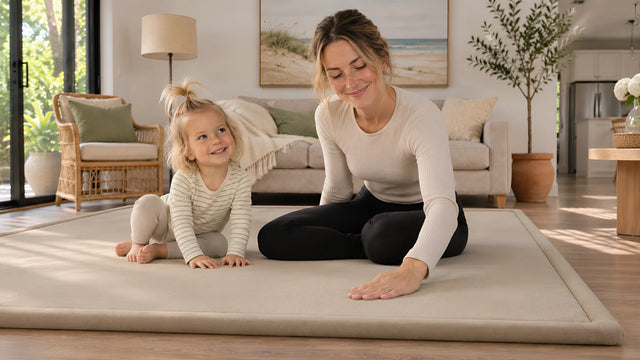
Play mats that look like a rug
How a hand-knotted rug is made
A knotted rug begins as rows of strong threads stretched tightly on a loom. A weaver ties a small knot of yarn around those threads individually, then packs each completed row down with a crosswise thread before starting the next one. A large rug contains an enormous number of knots and can take many months to finish.
In this construction, the knots themselves form the rug. No glued backing holds anything together, and the fringe is usually the natural ends of the loom threads rather than decorative trim added later. That structure is why knotted rugs are so often passed down through families, and why they cost more.

Flip the corner: the back tells you how a rug was made.
How to tell them apart: flip the corner
The quickest way to identify a rug's construction is to turn over one corner and examine the back.
- Hand-knotted: the pattern appears on the back, almost like a softer copy of the front, and the tiny knots look slightly uneven, which is a sign of handwork.
- Hand-tufted: a flat sheet of fabric, often similar to canvas, covers the back, and the design underneath is hidden.
- Fringe: on a knotted rug the fringe grows out of the rug itself, while on a tufted rug it is often stitched onto the edge.
The label and the seller's product description can confirm what you see, since many sellers list the construction method clearly.
How they feel, shed and wear
From the front, a well-made tufted rug and a well-made knotted rug can look remarkably alike. Underfoot, tufted rugs often feel plush and springy because the pile is dense and even, while knotted rugs tend to feel flatter and firmer, with a subtle handmade texture.
New wool rugs of either type may shed at first as loose fibers work their way out of the pile. Tufted rugs are especially known for shedding during the early months, and gentle, regular vacuuming usually reduces it over time.
Over the years, the difference becomes more noticeable. The adhesive in a tufted rug's back can dry out and weaken, allowing tufts to loosen. A knotted rug has no adhesive to break down, so with proper care it generally lasts much longer.
Side by side
| Hand-tufted | Hand-knotted | |
|---|---|---|
| How it's made | Yarn punched through cloth with a tool | Knots tied one by one on a loom |
| Time to make | Much faster | Many months for a large rug |
| Back | Flat fabric, design hidden | Pattern shows through |
| Fringe | Often sewn on | Part of the rug |
| Shedding | Often more at first | Some at first |
| Cost | Lower | Higher |
| How long it tends to last | Shorter | Much longer, with care |
| Cleaning | Gentle, keep water from soaking the back | Gentle, a professional clean for big jobs |
What both rugs dislike in a family room
Handmade rugs are designed for feet and furniture, not for daily snacks on the floor. Whichever type you own, a few everyday situations are particularly hard on it.
- Spills that soak in: milk, juice and water can sink through the pile, reaching the glued back of a tufted rug or leaving a mark in the fibers of a knotted one.
- Crayons and markers: color pressed deep into the pile is difficult to lift, and harsh cleaners can damage the dyes.
- Toy wheels and sharp edges: hard wheels and pointed toys can snag loops and pull at tufts.
- Picking and chewing: a curious crawler may tug at a loose tuft or mouth the fringe.
- The same spot every day: one busy play area wears faster than the rest of the rug.
None of this means you need to roll the rug up and put it away. It simply means the rug and the play area work better as two different places. If you're still deciding whether a rug alone is enough, our comparison of a play mat vs an area rug explains when each one makes sense.
Keep the special rug, give play its own spot
Leave the knotted or tufted rug under the sofa and chairs, or in a room with less traffic. Then set up the play zone on the bare floor beside it, using a mat designed for spills, building and crawling. For awake, supervised play. Not for sleep.

A one-piece mat handles the messy jobs a handmade rug would rather avoid. When something spills, blot first, then clean just the spot with a damp cloth, working from the outside toward the middle, and let the area dry flat. Our care guide covers the complete routine, and the mat vacuums like a rug.
Two details keep it working well. The non-slip backing is made to stay put on hardwood, tile and laminate, but it isn't tested on top of another rug, so position it on the bare floor next to your rug instead of over it. Keep furniture off the mat and its edges as well.
For sizing, the Living Room mat measures 5 × 6.5 ft, about the size of a queen bed. To choose a mat color that complements the rug you already love, try our rug color matching guide.
FAQ
Is a hand-tufted rug worse than a hand-knotted rug?
Not worse, just different. A tufted rug is quicker to produce and more affordable, while a knotted rug takes much longer, costs more and usually lasts longer. Choose based on your budget and how much daily use the room will get.
Why is my new hand-tufted rug shedding?
Loose fibers left over from production work their way out during the first months, which is common with new tufted wool rugs. Vacuum gently and regularly, and the shedding usually decreases. If entire tufts pull out, contact the seller.
Can I put a play mat on top of my wool rug?
Our non-slip backing is designed for hard floors and isn't tested on top of another rug. It's better to place the mat on the bare floor beside the rug and keep the rug in the seating area.
How should I clean a hand-knotted rug?
Vacuum gently, blot spills right away and avoid soaking it. For large stains or a deep clean, many owners hire a rug cleaner experienced with handmade rugs.
Find a mat that looks at home beside your favorite rug in our collection of play mats that look like a rug.
Written by the Poco Koko team.
Keep reading in Floors & materials
- Free shippingContiguous U.S. (48 states)
- Pre-orderShip timing is on each mat's page
- 30-day returnsOn unused mats
- 1-year warrantyOn every mat