
Montessori Playroom Ideas: How to Set Up a Simple Play Area at Home
By The Poco Koko team · Updated Nov 17, 2026 · 6 min read

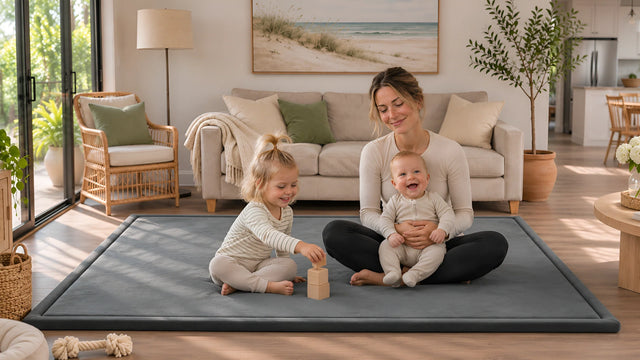
Shown in our 6.5 × 10 ft size, on the way.
On this page
A Montessori playroom does not need a whole room or a big budget. At home, it mostly comes down to a soft floor, a low shelf, a few toys your child can reach on their own, and a calm space with plenty of room to move. Most families can set one up in a corner of the living room in a single afternoon.
This guide walks through each piece in plain language: the floor, the shelf, how many toys to put out, how to rotate them, where a mirror goes and how to mount it safely, and the small mistakes that make a space feel busy. You will not need any special furniture or expensive materials to get started.
What a Montessori play area really is
Montessori is an approach to early learning that started with Dr. Maria Montessori, an Italian doctor and educator, more than a century ago. At home, the idea is simple. You set up a space where your child can see their choices, reach them without help, and put them back when they are finished.
That means a few things in practice:
- Everything sits low: toys, books and baskets are at your child's height, not yours.
- Fewer choices: a handful of toys on display instead of a full bin.
- A calm look: soft colors, natural materials and open floor.
- Room to move: clear space to sit, crawl, roll and play.
It does not have to be a separate room. Many families create a Montessori corner in the living room, close to where the grown-ups already spend most of their day. If space is tight, our small playroom ideas show how to fit a play zone into a few square feet.
Start with a soft floor
The floor is where most play happens, so it is the natural place to start. Your child will sit, kneel and sprawl there for long stretches, and you will sit right beside them. A soft, steady surface makes that time comfortable for everyone in the family.
Look for one continuous floor surface rather than a patchwork of small mats. A single piece keeps the space looking calm and gives your child one clear place to play. It also helps to choose a mat that sits low and flush to the floor, so it is easy to step or crawl on and off without a big edge in the way.
Our play mat is one piece, with no seams and no puzzle tiles to pull apart. It has a velvety-soft top, a thick, plush foam core and a non-slip backing that stays put on hardwood, tile and laminate. It is finished like a real rug, so it suits the soft, natural look many Montessori spaces aim for. The Living Room size is 5 × 6.5 ft (59 × 79 in), about the size of a queen bed, which works well for a living room corner. Mushroom (a warm beige) and Charcoal are easy neutrals, and Rosemary Green is a soft green floral print. For awake, supervised play. Not for sleep.
Many parents care about materials, too. Our mat is made with CertiPUR-US® certified foam. All three layers, the top fabric, the Loft Foam core and the backing, are OEKO-TEX® STANDARD 100 certified. You can read more on our materials and testing page.
All play mats
Add a low shelf, just off the mat
A low, open shelf is the heart of a Montessori play area. It lets your child see everything that is available and choose for themselves, without asking an adult to open a bin. Natural wood looks warm and works with almost any style of room.
Two details matter more than the shelf itself:
- Set it on the hard floor: place the shelf against the wall on the bare floor, just off the edge of the mat. A shelf resting on the soft edge of a mat can tip or wobble.
- Anchor it to the wall: a child who pulls up on furniture will use the shelf for support. Use the anti-tip kit if it came with one, or a furniture strap, and screw it into the wall.
Keep the shelf low and wide rather than tall and narrow. Two or three levels is plenty for a young child, and a wide top gives you a spot for a plant or a basket.
Put out fewer toys
Fewer toys on the shelf often leads to more focused play. When a child sees eight things instead of forty, it is easier for them to pick one and stay with it for a while.
A simple way to set up the shelf:
- Six to eight items: one toy or activity per spot, with space around each one.
- Use trays and baskets: a small tray or basket holds the parts of one activity together.
- Open-ended toys: wooden blocks, stacking rings, simple wooden puzzles, play silks and a few board books.
- Real, simple objects: a small wooden spoon and bowl, a soft ball, a basket of fabric scarves.
Leave some empty space on each level of the shelf. A shelf that is not packed looks calmer, and the open spots show your child exactly where each item goes back.
Rotate toys every week or two
Toy rotation keeps the shelf feeling fresh without buying anything new. You put most of the toys away in storage and bring just a few out at a time.
Here is an easy routine:
- Split the toys into groups: sort them into three or four small sets.
- Store the rest out of sight: a closet bin or a high shelf works well.
- Swap one set at a time: every week or two, or when you notice a toy being ignored.
- Keep favorites out: if one toy is loved every day, leave it on the shelf.
A rotation also makes cleanup quicker at the end of the day, because there is simply less to put away each night.
Mount a mirror securely to the wall
A low mirror is a common feature in Montessori spaces for babies and young toddlers. Many little ones enjoy watching their own faces and movements while they play on the floor.

Screw the mirror flat to the wall, with the bottom edge on the baseboard.
How you mount it matters. Choose an acrylic safety mirror rather than glass, and screw it flat to the wall at floor level, with the bottom edge resting on the baseboard. Never lean a mirror against the wall or set it on a stand on the floor, where a child could pull it over. A wall-mounted mirror right next to the mat gives your child a clear view from where they sit.
Make a cozy book spot
Books belong in a Montessori play area too. A small front-facing book ledge or a basket of board books lets your child see the covers and choose a story on their own. Keep just a few out at a time and swap them along with the toys.
Add a floor cushion at the edge of the mat, and you have a cozy reading corner where the two of you can sit together. For a calm, uncluttered look across the whole room, see our tips on a play rug in a minimalist home.
Common mistakes to skip
- Too many toys at once: a full shelf can feel like a full bin.
- Bright, busy colors everywhere: a few colorful toys are fine, but a calm base helps.
- A leaning mirror: always screw it to the wall.
- An unanchored shelf: strap it to the wall, even if it is short.
- A shelf on the mat edge: keep it on the hard floor, just off the mat.
For more ways to build a play space around the floor, our playroom ideas cover layout, storage and zones.
FAQ
Do I need a separate room for a Montessori playroom?
No. A corner of the living room works well. All you need is a soft floor, a low shelf, a few toys and some open space.
How many toys should be out in a Montessori play area?
Many families keep six to eight items on the shelf and store the rest. Swap a few out every week or two to keep things fresh.
Where should a mirror go in a Montessori space?
Use an acrylic safety mirror and screw it flat to the wall at floor level, near the play mat. Never lean a mirror on the floor.
What kind of floor works for a Montessori play area?
A soft, steady surface in one piece that sits low on the floor. A neutral color keeps the space calm and matches wooden toys and shelves.
Build your Montessori corner on a soft, rug-like floor with our play mats for the living room.
Written by the Poco Koko team.
- Free shippingContiguous U.S. (48 states)
- Pre-orderShip timing is on each mat's page
- 30-day returnsOn unused mats
- 1-year warrantyOn every mat