
Playroom Wallpaper Ideas: Busy Walls, Quiet Floors and How to Pair Them
By The Poco Koko team · Updated Nov 17, 2026 · 5 min read

Shown in our 6.5 × 10 ft size, on the way.
On this page
The simplest rule for playroom wallpaper is this: the busier the wall, the quieter the floor. A bold pattern looks its happiest above a plain, solid play mat, while a printed mat pairs well with calm, subtle wallpaper. Choose one of the two to be the star, and let the other one support it.
After that, a few practical choices matter most in a room where kids play. You need to decide between peel-and-stick and paste, how washable the finish should be, and whether the paper covers one wall or the whole room. This guide walks through each choice, then shows where wallpaper earns its place in a playroom.
Pair the wallpaper with the floor
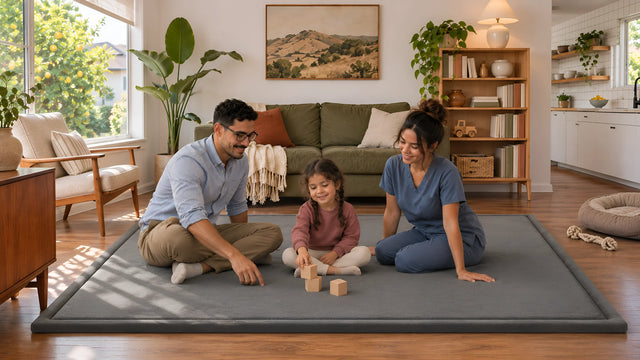
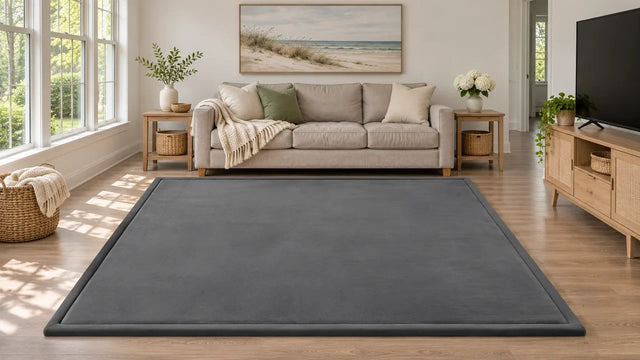
Before you fall for a pattern, look at what is on the floor, since a playroom has room for one loud surface and not two. Our main guide to playroom ideas built from the floor up shows how the play floor anchors the rest of the room. On the floor side, the Living Room size gives you four colors to pair with. Charcoal and Mushroom, a warm beige, are plain solids. Rosemary Green carries a soft green floral print, and Marisol Blue has a calm abstract blue print.
| Wallpaper style | Mat that pairs well | Why it works |
|---|---|---|
| Bold, large-scale pattern (big florals, wide stripes, animals) | Charcoal or Mushroom | the solid floor gives the eye a place to rest |
| Colorful mural | Charcoal | a deep floor grounds a colorful wall |
| Small, subtle print (tiny dots, fine grid, soft texture) | Rosemary Green or Marisol Blue | the floor print stays the star, and the wall adds gentle texture |
| Grasscloth look or plain textured paper | any of the four | texture without pattern works with prints and solids alike |
If you love a bold paper and a printed mat, put them on opposite sides of the room so they never sit in the same view. To see how a calm abstract print looks up close before you choose a wall, take a look at the Marisol Blue play mat.

Peel-and-stick or traditional paste?
Both types can work in a playroom, and the right one depends on your walls and how long you plan to keep the look. The main differences are shown below.
- Peel-and-stick: a self-adhesive paper that you can put up and take down again without paste. It suits renters and anyone who expects to change the room as kids grow. It may not stick well to textured walls, and fresh paint usually needs time to cure first, so follow the maker's directions.
- Traditional paste: paper hung with wallpaper paste, either pre-pasted or paste-the-wall. It tends to hold up better over the long run and copes with more wear, but it takes more work to hang and to remove.
Whichever type you pick, order a sample first. Tape it up beside the play area for a few days, and look at it in morning and evening light.
Play mats for the living room
Choose a finish you can wipe
Playroom walls collect sticky handprints, crayon marks and the occasional splash. Check the label for a washable finish, which can be wiped with a damp sponge, or a scrubbable one, which stands up to firmer cleaning. In the lower part of a playroom, scrubbable is the easier choice.
A matte or low-sheen finish hides small marks better than a shiny one. Before the first real clean, test your cleaning method on a scrap or a hidden spot, the same way you would with any new surface.
One accent wall or the whole room?
An accent wall is the easiest place to start, since it costs less, usually goes up in an afternoon, and gives you a bold look without filling the whole room. The whole room works too, but it suits small, subtle patterns much better than large ones.
- Behind the play floor: the wall that the mat faces is the one kids look at most, so it is a natural spot for an accent.
- Behind a reading corner: a soft pattern behind cushions and a book basket marks that corner as its own small zone.
- The whole room: use a quiet, small-scale paper, so the room still feels calm when the toys come out.
- The ceiling: a light, airy pattern overhead adds fun without competing with the floor.
Our guide to whether a dedicated playroom is worth it can help if you are still deciding how much of the room should feel like a playroom at all.
A mural on the wall the play floor faces
A mural is a big, single picture spread across one wall, such as a forest, a meadow or soft hills. It works well on the wall a child sees while sitting on the mat, because that is the view they get during most of their play. Choose one with soft colors and no lettering, so the wall feels like a window into another place.
Keep the furniture in front of a mural low. A low shelf or a row of baskets lets the picture show, while a tall bookcase would hide most of it.

Wallpaper above, wipeable below
The lower part of a playroom wall takes the most wear, from toy cars and ride-on toys to hands that just got back from snack time. A smart layout puts wallpaper on the upper part of the wall and a wipeable surface below it.
- Paint below a rail: a chair rail or a simple trim line with scrubbable paint underneath and wallpaper above.
- Beadboard or paneling: a wood panel on the lower third of the wall, painted in a washable finish.
- A tall rail: in a room with high ceilings, set the line a bit higher, so the wallpaper starts above where little hands reach.
This layout also helps in shared spaces. Our guide to a play area in the living room shows how a play zone can share a wall with the rest of the room.
Hang the paper before the mat goes down
Hanging wallpaper is messy work, with paste, water, ladders and long strips of paper everywhere. Hang it first, let the walls dry fully, and clean up any scraps before you lay out the mat. If the mat is already down, roll it up and move it to another room while you work.
When the mat goes back, keep furniture off it and off its edges, and leave a small gap between the mat and the freshly papered wall. For awake, supervised play. Not for sleep.
FAQ
What kind of wallpaper is good for a playroom?
A washable or scrubbable wallpaper is the most practical choice for a playroom. Peel-and-stick suits renters and rooms you expect to change, while traditional paste usually holds up better over time.
Should a playroom have wallpaper on every wall?
Not usually. One accent wall is easier to hang and easier to live with, and a whole room works better with a small, quiet pattern.
What play mat goes with bold wallpaper?
A solid mat, such as Charcoal or Mushroom, gives a bold pattern room to stand out. Save the printed mats, Rosemary Green and Marisol Blue, for rooms with calm, subtle walls.
Is peel-and-stick wallpaper good for kids' rooms?
It can be, since it is easy to change as kids grow. Check that it suits your wall texture, and follow the maker's directions on fresh paint.
Find a solid or printed mat to pair with your new wallpaper in our collection of rug-like living room play mats.
Written by the Poco Koko team.
Keep reading in Playrooms & living rooms
- Free shippingContiguous U.S. (48 states)
- Pre-orderShip timing is on each mat's page
- 30-day returnsOn unused mats
- 1-year warrantyOn every mat