
Nugget Couch Ideas: 10 Low Builds to Try on a Play Mat
By The Poco Koko team · Updated Nov 17, 2026 · 5 min read

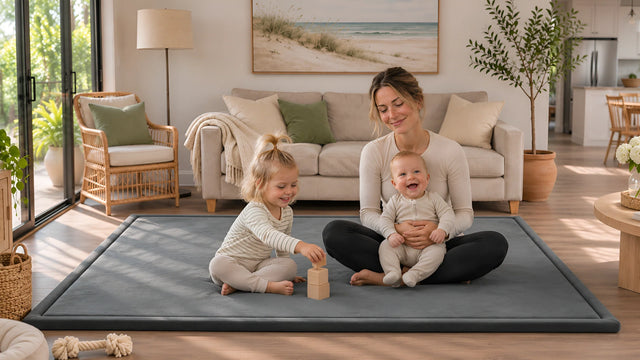
Shown in our 6.5 × 10 ft size, on the way.
On this page
Play couch builds work well when they stay low to the ground, because forts, tunnels, boats and reading nooks give kids a whole imaginary world without anyone climbing high. If you searched for Nugget couch ideas, the builds below work with most modular foam play couches, which often come as a base, a seat cushion and a couple of smaller pillows.
Where you build matters as much as what you build. On a one-piece play mat, the base stays in place, the floor surrounding the fort is cushioned, and the finished edge shows everyone exactly where the building zone ends. Below you will find 10 easy builds, a few house rules, and a simple way to organize the space.
Why build on a play mat
Foam couch pieces are lightweight, which is wonderful for small builders, but it also means they can scoot across a smooth floor whenever a child leans against a wall of the fort. Putting a play mat underneath solves most of that problem.
- The base stays put: our mat is one piece, with no puzzle tiles to pull apart. Its non-slip backing stays put on hardwood, tile and laminate, so the whole build has a steady floor.
- A soft landing all around: walls fall over, and kids tumble out of forts. The thick, plush foam gives a little when they land, so a tipped wall is no big deal.
- A clear play zone: the mat is finished like a real rug, with a neat edge. Kids learn that the build lives on the mat, and the pieces come back to it at cleanup time.
For more ways to arrange a whole room around the floor, browse our playroom ideas, which start with the play surface and build outward.
10 low builds to try
Each of these builds uses only the couch pieces, plus a cotton sheet or a play silk for a few of them. Start with the base lying flat on the mat, then add the other pieces one at a time and test each one as you go.
- The classic fort: stand two pieces on their long edges to make walls. Drape a light sheet over the top and leave one end open as the door.
- The crawl tunnel: set two pieces on their sides, a little apart, and lay a sheet across them. Kids crawl in one end and out the other, and a grown-up can wave from the exit.
- The boat: lay the base flat and prop a cushion up at one end as the bow. The mat becomes the sea, and a wooden spoon makes a fine oar.
- The race car: line the pieces up in a row as seats, with a round wooden lid as the steering wheel. Passengers take turns being the driver.
- The throne: use the base as the seat, a cushion as the back, and the small pillows as arms. It works for story time, a pretend king or queen, or a grown-up who needs a rest.
- The reading nook: lean a cushion against a wall and set the base in front of it. Add a basket of books and one soft light nearby. Our guide to a kids reading corner has more ideas.

- The stepping stones: lay every piece flat in a loose path across the mat. Kids step from stone to stone, and anyone who slips just lands on the mat.
- The puppet theater: stand one piece up on its long edge as a stage. Puppeteers kneel behind it, and the audience sits on the mat in front.
- The shop counter: use the same standing piece as a counter. Wooden fruit, a felt wallet and a paper sign without words are all you need.
- The crawl course: for babies who crawl, lay the pieces flat as gentle bumps to cross. A grown-up sits on the mat right beside them. For awake, supervised play. Not for sleep.
All play mats
House rules for building
A few simple rules keep fort time fun for everyone. Say them out loud before the first piece goes up, and they quickly become a familiar part of the game.

- Couch pieces only: build with the play couch and soft cloth. Leave out chairs, step stools and the cushions from your real sofa.
- Keep it low: builds should be easy to sit in, crawl through or step across. Skip towers, ramps off furniture and anything kids would jump down from.
- A grown-up stays close: sit on the mat or right beside it while kids build and play. You can be the guest, the customer or the person in the boat.
- Build in the middle: set up away from coffee tables, shelves and sharp corners. That way a falling wall lands on the mat, not against furniture.
- Check before you climb in: give each wall a gentle push. If it wobbles, lay it flat or build it another way.
Setting up the play zone
Pick a spot with open floor on every side and nothing heavy or sharp nearby. A living room is often a good choice, since the grown-ups are usually there anyway. Our guide to a play area in the living room walks through the most practical places to put one.
Plan the space around the builds your family enjoys. Our Living Room size is 5 × 6.5 ft (59 × 79 in), which is about the size of a queen bed and gives a fort room to spread out with space left for a grown-up at the edge. For families who like to build big, larger 6 × 9 ft and 6.5 × 10 ft sizes are on the way. Our size guide shows the mat on a room plan.
Keep a cloth basket beside the mat for sheets, play silks and wooden props, so that everything has a home when play is over.
Cleanup without the fuss
Ask kids to carry each piece back to the mat and stack it neatly along one edge. Cleanup becomes one more game, and it finishes play time on a calm, predictable note.
Once the pieces are off, the mat vacuums like a rug, and any sticky spot wipes clean easily with a damp cloth. If you are wondering how a one-piece mat compares with interlocking foam tiles for this kind of active play, our one-piece vs puzzle play mat guide compares them side by side.
FAQ
What can you build with a play couch?
Low builds work well, including forts, tunnels, boats, race cars, a throne, a reading nook and stepping stones. Keep every build close to the floor and set it up on a soft, steady surface.
Do you need a mat under a play couch?
You do not strictly need one, but it helps in several ways. A one-piece mat with a non-slip backing gives the build a steady base, cushions falls around it, and clearly marks out the play zone.
Can babies play on the builds?
Crawling babies can enjoy pieces laid flat as gentle bumps, with a grown-up sitting on the mat beside them the whole time. Keep babies out of covered forts and tunnels. For awake, supervised play. Not for sleep.
Can kids nap in a fort?
Forts are for play time only. When a child starts getting sleepy, move them to their own bed and take the fort down afterward.
How big should the mat be for a play couch?
Choose a size that leaves open space around the build and enough room for a grown-up to sit comfortably. The size guide compares each available size on a room plan.
Find a soft, steady base for your next fort in our collection of play mats for the living room.
Written by the Poco Koko team.
- Free shippingContiguous U.S. (48 states)
- Pre-orderShip timing is on each mat's page
- 30-day returnsOn unused mats
- 1-year warrantyOn every mat