
Playroom Couch and Play Mat: How to Pair Them in One Play Zone
By The Poco Koko team · Updated Nov 17, 2026 · 5 min read

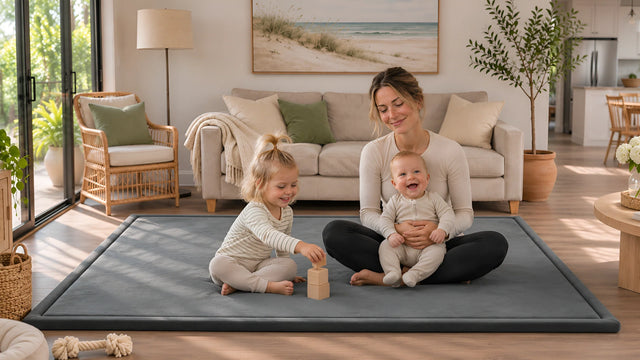
Shown in our 6.5 × 10 ft size, on the way.
On this page
A kids' play couch and a one-piece play mat make a great team. Lay the mat down first as the floor of the play zone, park the couch along one edge, and let the cushions come onto the mat whenever it's time to build. The couch gives kids shapes to climb, lounge on and turn into forts, while the mat gives everyone a soft, steady floor underneath, grown-ups included.
This guide explains what each piece does, gives our real mat size with a quick way to check your couch, and walks through four floor plans for a playroom or a living room. It finishes with the question most families forget to plan for: where the grown-ups will sit.
What each piece does
A play couch is a set of foam cushions with fabric covers that children can rearrange into a couch, a lounger, a tunnel or a fort. The pieces are light enough for small hands to drag around, which is the whole point, and also why a build is always about to tip over.
- The play couch is the building material: cushions to stack, lean, crawl under and flop onto.
- The play mat is the ground: one piece, no seams, no puzzle tiles to pull apart, with a thick, plush foam core that gives a little when they land.
- Together they make one zone: the couch sets the edge of the space, and the mat marks out where play happens.
Because the mat is finished like a real rug, it also keeps the space looking like part of the house instead of a gym floor. For more ways to plan the whole room around play, see our playroom ideas. If you're still weighing foam tiles against one solid piece, our comparison of one-piece and puzzle play mats covers seams and gaps.
Our mat at a glance
Here is the real size, short side first, so you can compare it against your couch and your floor.
| Mat size | In inches | About the size of | Colors |
|---|---|---|---|
| Living Room, 5 × 6.5 ft | 59 × 79 in | A queen bed | Charcoal, Mushroom, Rosemary Green, Marisol Blue |
Larger 6 × 9 ft and 6.5 × 10 ft sizes are on the way.
Play couches vary a lot in size, so measure yours in two shapes: set up as a couch, and with every piece laid out flat. Then mark the mat's outline on your floor with painter's tape and place the couch beside it in both shapes.
- If the couch shape takes a strip along one edge: you still have open floor in the middle for building, reading and rolling around.
- If the laid-flat couch covers almost the whole rectangle: builds will spill onto bare floor, so plan to build in smaller sections.
- If two kids share the zone: picture both of them, plus a grown-up, sitting inside the tape at once.
Our size guide has the full taping method and the measurements for each room.
All play mats
Where the couch parks between builds
Our care guide notes that the mat lies flattest with no furniture on top. During play, cushions belong on the mat, because that's where a tumbling fort should land. When the couch is back in couch shape for the evening, though, set it on the floor right at the mat's edge with the seat facing the mat.
That parking spot has a nice side effect. Kids step down from the couch straight onto the soft surface, and the mat stays clear for the next round of play.
Four floor plans that work
Every room is different, but most setups fall into one of these four shapes. Pick the one closest to your space and adjust from there.
- Couch against the playroom wall: park the couch along the longest wall and lay the mat in front of it, long side to the couch. Keep shelves on the side walls and a cloth basket in one corner, so the middle stays open.
- Corner reading nook: if your couch pieces bend into an L, tuck them into a corner and let the mat fill the space in front. Add a low book ledge within reach, and the corner becomes a place to read and rest between builds.
- Living room, beside the grown-up sofa: lay the mat in front of the family sofa and park the play couch at the open end of the mat, out of the walkway. Our guide to the rug between the sofa and the TV helps you measure that gap first.
- Small or shared room: stack the couch into its most compact shape against a wall, and roll the mat away when you need the floor back. The whole mat rolls up, so the room can switch jobs in a few minutes.

A corner nook: couch as backrest, mat as the floor.
Whichever plan you choose, keep big builds away from windows, the TV and tall shelves, so a climber never ends up within reach of them. The Consumer Product Safety Commission also recommends anchoring TVs and furniture like bookcases and dressers to the wall.
Where grown-ups sit
A play zone works better when a grown-up can settle in comfortably for a while. Plan your own seat when you plan the layout, rather than perching on the edge of a cushion.
- On the mat, back to the wall or sofa: the thick, plush foam is comfortable to sit on, and you're right at eye level for building.
- On the play couch: check the couch maker's weight guidance before a grown-up sits or leans on it, because many are sized for kids.
- Nearby on the real sofa: for longer stretches, a seat at the edge of the zone keeps you close without crowding the builders.

When a baby is on the mat, move the couch cushions to one side so the floor around them stays clear and flat. Keep it for awake, supervised play. Not for sleep. Once the baby starts crawling, the cushions can come back in as low hills to climb over.
Builds that suit a mat
Low, wide builds are easier to manage than tall towers, and they land softly when they come apart. A few favorites: a tunnel of cushions to crawl through, a low fort with a cloth sheet over the top, a path of flat cushions to walk across, and a reading nest with the couch as the backrest. For more ideas, see how play couch builds work on a one-piece mat.
At the end of the day, stack the cushions back into couch shape and vacuum the mat like a rug. Sticky spots wipe clean easily with a damp cloth, and the couch covers can be cleaned according to their own label.
FAQ
What is a playroom couch?
A playroom couch, or play couch, is a set of foam cushions with fabric covers that kids can rearrange into a couch, a fort, a tunnel or a lounger. It works well as the building material on top of a soft play mat.
Do I need a play mat under a play couch?
You don't strictly need one, but a one-piece mat gives the zone a soft floor with no seams or tiles to shift, and its non-slip backing stays put on hardwood, tile and laminate.
What size play mat goes with a play couch?
Measure your couch set up and laid flat, then tape out the mat on the floor. The Living Room mat is 5 × 6.5 ft, about the size of a queen bed.
Can the play couch stay on the mat all the time?
During play, yes. Between builds, park it on the floor at the mat's edge, since the mat lies flattest with no furniture on top.
Build your play zone on one of our play mats for the living room.
Written by the Poco Koko team.
- Free shippingContiguous U.S. (48 states)
- Pre-orderShip timing is on each mat's page
- 30-day returnsOn unused mats
- 1-year warrantyOn every mat