
Toy Rotation: A Simple After-the-Holidays Plan for Fewer Toys on the Floor
By The Poco Koko team · Updated Nov 18, 2026 · 5 min read

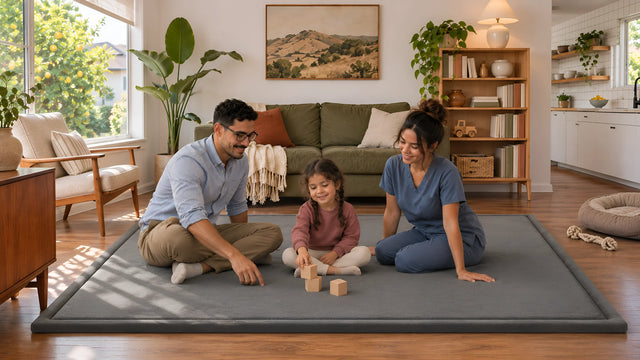
Shown in our 6.5 × 10 ft size, on the way.
On this page
- What toy rotation looks like at home
- Step 1: Gather everything in one place
- Step 2: Sort by type of play
- Step 3: Build a few small sets
- Step 4: Store the rest in labeled bins
- Step 5: Put one basket on the mat at a time
- Step 6: Choose a rotation day
- Step 7: Clear the floor when you need the room
- What to do with new gifts
- FAQ
Toy rotation means keeping a small set of toys out and storing the rest, then swapping them on a set day. After the holidays, it's one of the quickest ways to handle the new pile: sort everything once, keep one small set in the play area, pack the rest into labeled bins and trade one bin for another every week or two.
The benefits are simple and practical. There's less to pick up at night, the floor is easier to vacuum, and toys that were packed away often feel new again when they return. Below is a step-by-step plan, along with a way to set up the play mat so only one basket is out at a time.
What toy rotation looks like at home
Rotation isn't about owning fewer toys. Everything stays in the house, but it isn't all out at the same time. A shelf with a few carefully chosen things and one basket on the floor is usually enough for a full day of play.
It works especially well in a living room, where toys share the space with grown-ups and their furniture. For ideas on shaping the whole play space, see our playroom ideas.
Step 1: Gather everything in one place
Pick a quiet hour, like nap time or after bedtime, and bring every toy into one room. Include the new gifts, the toys in the car and the ones hiding under the sofa. Seeing everything together makes the next decisions much faster.
As you go, set aside three piles:
- Broken or missing pieces: Fix what you can, and let go of the rest.
- Outgrown toys: Pass them on to a younger cousin or a friend, or donate them.
- Duplicates: Two of the same thing can go into different sets.
Play mats for the living room
Step 2: Sort by type of play
Group the toys by how your child actually plays with them, not by size or color. Sorting this way makes it easier to build balanced sets in the next step.
- Building: Wooden blocks, magnetic tiles, stacking rings.
- Pretend play: Play food, dolls, animal figures, a toy tea set.
- Things that move: Wooden cars, a train track, push-along toys.
- Puzzles and sorting: Chunky wooden puzzles, shape sorters, nesting cups.
- Books: A few favorites, plus the new ones.
- Art and music: Crayons, a drum, shakers, a small xylophone.
Step 3: Build a few small sets
Now divide each group across three or four sets. Each set gets a little of everything, so no single week is all puzzles and no blocks. Here's one example of how that might look:
| Type of play | Set A | Set B | Set C |
|---|---|---|---|
| Building | Wooden blocks | Magnetic tiles | Stacking rings |
| Pretend | Play food | Animal figures | A cloth doll |
| Moving | Wooden cars | Train track | A push-along toy |
| Puzzles | Shape sorter | Two wooden puzzles | Nesting cups |
| Books | Four books | Four books | Four books |
How many toys belong in a set depends on your space and your child. A helpful test is whether the whole set fits on one shelf and in one or two baskets without crowding. In a tight space, smaller sets work better, and our small playroom ideas show how to make a little floor go further.
Keep a few anchor toys out all the time. A favorite stuffed animal, the blocks that get used every single day or a toy that travels everywhere doesn't need to rotate.
Step 4: Store the rest in labeled bins
Put each extra set in its own bin, so a swap simply means trading one bin for another. Lidded cloth bins or wooden crates on a closet shelf, or a low bin under a bed, keep the stored sets out of sight.

- Label every bin: Write the set name, or tape a photo of what's inside to the front.
- Store sets with small pieces up high: If an older sibling's set has small parts, keep it out of a younger child's reach, and check the age on each box.
- Keep bins light: You'll be carrying them every week or two.
For more ways to hide toys in a room that grown-ups use too, see our living room toy storage ideas.
Step 5: Put one basket on the mat at a time
The play mat is where each set actually gets used. Place the shelf beside the edge of the mat and bring out one basket at a time. When your child finishes with the blocks, they go back in their basket before the cars come out.

This keeps the play area clear, and the cleanup at the end of the day becomes one basket instead of an entire floor. Because the mat is one piece, with no seams and no puzzle tiles, small blocks don't slip into gaps between pieces. It vacuums like a rug, so a slow pass one way and then across picks up crumbs between baskets. Our comparison of one-piece and puzzle play mats explains the difference in more detail.
Step 6: Choose a rotation day
Pick a regular day for the swap, like Sunday evening, and try to stick with it. Once a week or every two weeks is a reasonable place to start, but there is no correct number.
- Swap after bedtime: Your child wakes up to a "new" shelf.
- Watch for signs: If a set sits untouched for days, it's time to trade it.
- Keep what's in use: If a toy is still a big hit, leave it out for another round.
- Let them help: Older toddlers can pick between two bins, which makes the swap feel like their choice.
Step 7: Clear the floor when you need the room
Sometimes you need the whole living room back, for a party, a visit from relatives or a holiday meal. Put the basket away and vacuum the mat first. Since it's a single piece, the whole mat rolls up from one end, so you can store it somewhere dry and lay it flat again when the room is yours, giving it time to settle. Our care guide has the details.
What to do with new gifts
The holidays are when rotation probably helps the most. You don't have to bring every new toy into the play area at once.
- Open everything, then sort: Let your child enjoy the unwrapping, then put some gifts straight into the bins.
- Spread gifts across sets: One new toy per set gives each swap something fresh.
- Note who gave what: A sticky note on each box makes thank-you photos easy when the toy comes out.
FAQ
How many toys should be out at once?
Only as many as fit on one shelf and in one or two baskets without crowding. Store the remaining toys in labeled bins and swap them on a regular day.
How often should you rotate toys?
Once a week or every two weeks is a reasonable starting point. Swap sooner if a set sits untouched, and leave a toy out longer if it's still a favorite.
Does toy rotation work with a baby?
Yes. A baby usually needs only a few things at a time, such as a soft book, a rattle or a set of stacking cups, which makes rotation easy to begin early. For awake, supervised play. Not for sleep.
What toys should stay out all the time?
A favorite stuffed animal, everyday building toys and the books your child requests again and again can stay out permanently. Rotate everything else.
Find a soft play zone that looks like a rug with our play mats for the living room.
Written by the Poco Koko team.
- Free shippingContiguous U.S. (48 states)
- Pre-orderShip timing is on each mat's page
- 30-day returnsOn unused mats
- 1-year warrantyOn every mat