
Living Room Toy Storage Ideas That Still Feel Like a Living Room
By The Poco Koko team · Updated Nov 17, 2026 · 5 min read

Shown in our 6.5 × 10 ft size, on the way.
On this page
The simplest toy storage for a living room starts with a few cloth or rattan baskets at the edge of the play mat. Add one low wooden shelf for favorites and a toy rotation that keeps most toys out of sight. When every toy has a home within arm's reach of where it gets played with, tidying up takes minutes instead of an evening.
Below are eight ideas that work together, from the play zone itself to hidden storage and a quick nightly reset. None of them needs plastic bins, and all of them leave the room looking like a place grown-ups want to sit.
1. Let the mat be the play zone
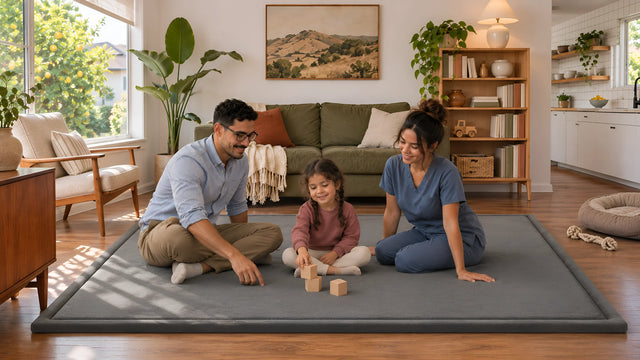
Toys spread when they have no edge to stop at. A one-piece play mat gives them that edge. Toys come out on the mat, get played with on the mat, and go back into baskets beside it, so the rest of the room stays clear.
It helps when the mat looks like it belongs. A mat finished like a real rug reads as part of the decor, with no seams and no puzzle tiles to pull apart. It also vacuums like a rug, so a quick pass after playtime keeps crumbs from settling into the plush. For more ways to plan a whole play space around the floor, see our playroom ideas.
2. Line up baskets along one edge

One basket, one type of toy.
Baskets are one of the most flexible kinds of toy storage, because they move wherever play happens and look like ordinary living room decor. Keep two or three along one side of the mat, not all around it.
- Rattan baskets: sturdy enough for blocks and wooden vehicles, and they look at home next to a sofa.
- Cloth baskets: soft sides, light enough for a toddler to drag over and fill.
- Felt bins: good for small things like play silks, finger puppets and soft balls.
- One basket, one type: blocks in one, books in another, animals in a third. It's easier for a toddler to remember where things go when each basket holds just one kind of toy.
Choose open-top baskets for everyday toys so little hands can tidy without help. Save lidded baskets for things that come out only with a grown-up, such as art supplies.
Play mats for the living room
3. Add one low wooden shelf

A few toys with space around them, anchored to the wall.
A low shelf next to the mat turns storage into a display. Set out just a few toys, with space between them, and stand picture books face out so the covers do the inviting.
Anchor the shelf to the wall, even if it is low. The Consumer Product Safety Commission recommends anchoring furniture such as bookcases and dressers to the wall, keeping heavier items on lower shelves, and not storing tempting toys up high where kids might climb for them.
This open-shelf style is a big part of a Montessori setup. Our guide to a Montessori play area shows how to arrange one around the floor.
4. Start a toy rotation
The fastest way to tidy a living room is to have fewer toys in it. A toy rotation keeps a small set out and the rest put away, then swaps them on a regular schedule.
- Pick a small set: choose a handful of toys that fit on the shelf and in the baskets without crowding.
- Store the rest out of the room: cloth bins on a closet shelf or under a bed work well.
- Swap every week or two: when the toys come back out, they often feel new again.
- Keep a few favorites: if one toy goes everywhere, leave it out of the rotation.
5. Choose furniture that hides toys
Some storage can blend into the room so well that guests never guess what is inside. Look for pieces that already belong in a living room.
- A storage ottoman: a fabric-covered ottoman with space inside holds bulky toys and doubles as extra seating.
- A wooden cabinet with doors: a low sideboard or media cabinet hides toys behind closed doors. Anchor it, like any shelf.
- A bench with baskets underneath: a wooden bench by the wall gives you a seat on top and two or three baskets below.
- A shallow cloth bin under the sofa: handy for flat things like puzzles and drawing paper.
6. Give books their own spot
Books get scattered fast, because they are light and every grown-up who sits down picks one up. A wooden book ledge or a fabric book sling on the wall near the mat keeps a few stories facing out and within reach. Swap them along with the toy rotation.
7. Build a five-minute reset
Storage only works when it gets used, so build a short routine into the end of each day. Do it together, and keep it the same every time.
- Toys into baskets: each one goes back into its own basket.
- Books onto the ledge: covers facing out, ready for tomorrow.
- A quick vacuum: one pass over the mat picks up crumbs before they settle.
- Baskets to the edge: line them up along the same side of the mat.
When the routine stays the same every night, a toddler may start to join in, and the reset gets shorter.
8. Roll the whole mat away when guests come

Toys in baskets, mat rolled up, room ready for guests.
Most days, the mat can simply stay down, because it looks like a rug. For a party or a busy holiday, a one-piece mat gives you another option. Put the toys in their baskets, vacuum the mat, then roll it up and stand it in a closet or behind the sofa.
Our care guide covers the details: vacuum it first, store it somewhere dry, and when it comes back out, lay it flat and give it time to settle again. The baskets slide onto a shelf or into a closet, and the room is ready for guests. If you are still deciding where the play zone should go, our guide on play mat placement in the living room walks through it.
For awake, supervised play. Not for sleep.
FAQ
How do I hide toys in the living room?
Use storage that looks like furniture, such as a fabric ottoman with space inside, a wooden cabinet with doors, or rattan baskets on a low shelf. A toy rotation also means fewer toys need hiding in the first place.
What kind of baskets are good for toys?
Open-top cloth, rattan or felt baskets work well, because a toddler can see inside and toss toys back in without help. Keep one type of toy in each basket.
How many toys should be out at once?
Only as many as fit on one shelf and in a few baskets without crowding. Store the rest elsewhere and swap them every week or two.
Can the play mat stay out when guests visit?
Yes. Because it is finished like a real rug, it can stay down once the toys are in their baskets. If you need the floor, it rolls up and stores in a closet.
Find a mat that anchors your play zone and looks like a rug in our play mats for the living room.
Written by the Poco Koko team.
Keep reading in Playrooms & living rooms
- Free shippingContiguous U.S. (48 states)
- Pre-orderShip timing is on each mat's page
- 30-day returnsOn unused mats
- 1-year warrantyOn every mat